
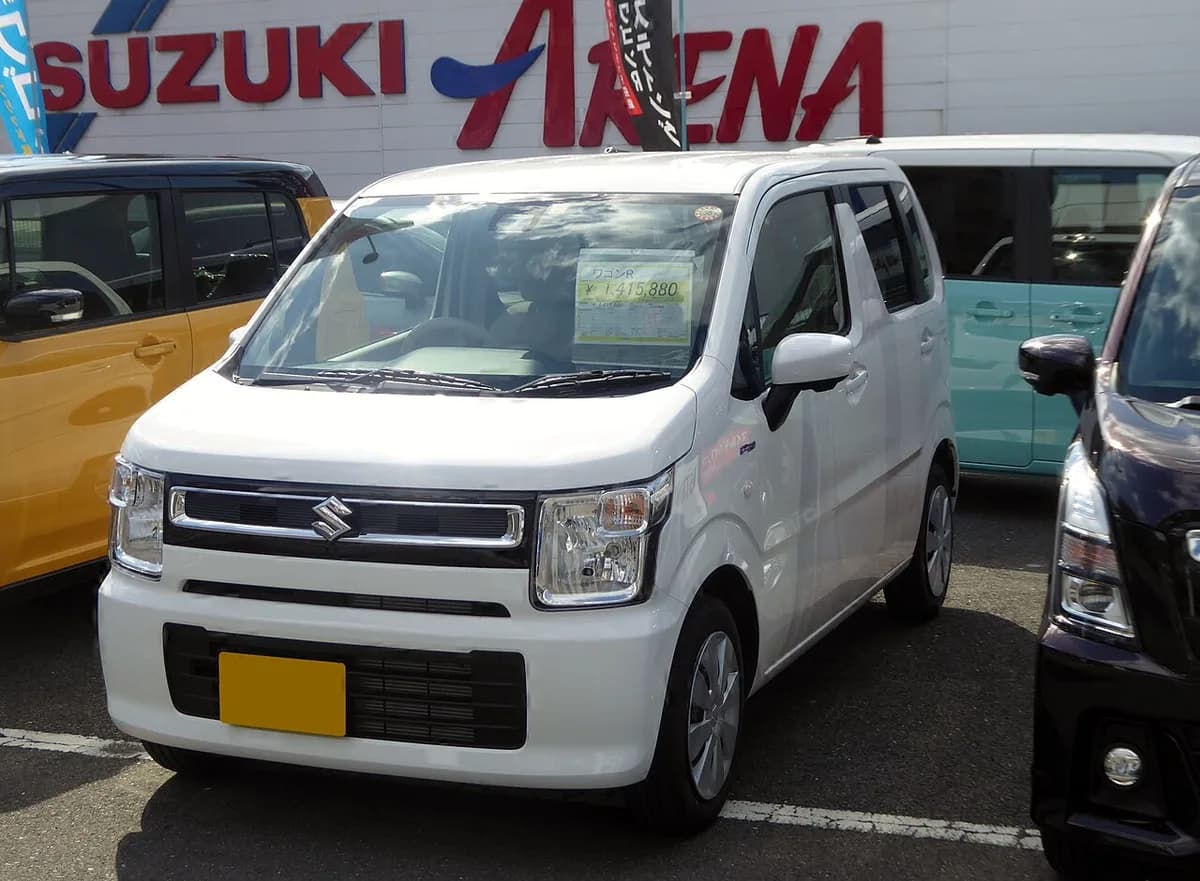

Wagon R MH55S
2017–2022
- Verified facts
- 52
- Parts references
- 23
- Maintenance items
- 4
- Documented campaigns
- 3
- Valuation
- Building
Pick up to three exact model codes. CarFactBook compares only information already present in the source-backed catalog — no generated scores and no invented winner.
Compare versions of one model in CarFactBook Time Machine →. Looking for a published model-code comparison? Browse source-backed chassis comparisons →
2017–2022
| Reference | Wagon R MH55S |
|---|---|
| Fuel tank capacity | 27 LSuzuki Motor CorporationView evidence → |
| 12V battery system architecture | Conventional 12V lead-acid battery plus a separate 12V mild-hybrid lithium-ion battery packSuzuki Motor CorporationView evidence → |
| 2017 Hybrid model-code mapping | DAA-MH55S · HYBRID FZ / HYBRID FXSuzuki Motor CorporationView evidence → |
| ABS / EBD — 2017 Hybrid | ABS with EBDSuzuki Motor CorporationView evidence → |
| Brake architecture — 2017 Hybrid | Disc front · leading-trailing rearSuzuki Motor CorporationView evidence → |
| Brake booster — 2017 Hybrid | Vacuum brake boosterSuzuki Motor CorporationView evidence → |
| Compression ratio — 2017 Hybrid | 11.5:1Suzuki Motor CorporationView evidence → |
| Curb weight — 2017 Hybrid | HYBRID FZ: 790 kg 2WD / 840 kg 4WD; HYBRID FX: 770 kg 2WD / 820 kg 4WDSuzuki Motor CorporationView evidence → |
| CVT forward ratio — 2017 Hybrid | 3.980–0.553Suzuki Motor CorporationView evidence → |
| CVT reverse ratio — 2017 Hybrid | 3.747Suzuki Motor CorporationView evidence → |
| Dimensions — 2017 Hybrid | 3,395 × 1,475 × 1,650 mmSuzuki Motor CorporationView evidence → |
| Drivetrain — 2017 Hybrid | 2WD front-wheel drive or full-time 4WD, depending on gradeSuzuki Motor CorporationView evidence → |
| DSBS sensor architecture — 2017 | Monocular camera + infrared laser radarSuzuki Motor CorporationView evidence → |
| Electric power steering — 2017 Hybrid | Electric power-assisted rack-and-pinionSuzuki Motor CorporationView evidence → |
| Engine bore × stroke | 64.0 × 68.2 mmSuzuki Motor CorporationView evidence → |
| Engine code | R06ASuzuki Motor CorporationView evidence → |
| Engine code and displacement | R06A · 658 ccSuzuki Motor CorporationView evidence → |
| Engine displacement | 658 ccSuzuki Motor CorporationView evidence → |
| Engine oil service interval | Non-turbo: 10,000 km / 6 months · Turbo: 5,000 km / 6 monthsSuzuki Motor CorporationView evidence → |
| Engine output — 2017 Hybrid | 38 kW (52 PS) at 6,500 rpmSuzuki Motor CorporationView evidence → |
| Engine torque — 2017 Hybrid | 60 N·m at 4,000 rpmSuzuki Motor CorporationView evidence → |
| Factory tyre size — 2017 Hybrid | 155/65R14 75SSuzuki Motor CorporationView evidence → |
| Final reduction ratio — 2017 Hybrid | 4.064Suzuki Motor CorporationView evidence → |
| Front track — 2017 Hybrid | 1,295 mmSuzuki Motor CorporationView evidence → |
| Fuel injection system — 2017 Hybrid | EPI electronic petrol injectionSuzuki Motor CorporationView evidence → |
| Fuel type — 2017 Hybrid | Regular unleaded gasolineSuzuki Motor CorporationView evidence → |
| Fuel-saving architecture — 2017 Hybrid | Hybrid system · charge-control idle stop · VVT · electric power steering · lock-up torque converter · CVTSuzuki Motor CorporationView evidence → |
| Ground clearance — 2017 Hybrid | 150 mmSuzuki Motor CorporationView evidence → |
| Head-up display — 2017 Hybrid | Displays vehicle speed and DSBS warningsSuzuki Motor CorporationView evidence → |
| HEARTECT platform — 2017 Hybrid | Lightweight, high-rigidity HEARTECT platformSuzuki Motor CorporationView evidence → |
| High-beam assist — 2017 Hybrid | Automatic high/low beam switchingSuzuki Motor CorporationView evidence → |
| Interior dimensions — 2017 Hybrid | 2,450 × 1,355 × 1,265 mmSuzuki Motor CorporationView evidence → |
| JC08 fuel economy — 2017 Hybrid | 33.4 km/LSuzuki Motor CorporationView evidence → |
| JC08 fuel economy — 2017 Hybrid 4WD | 30.4 km/LSuzuki Motor CorporationView evidence → |
| LED headlamps — 2017 HYBRID FZ | LED headlampsSuzuki Motor CorporationView evidence → |
| Mild-hybrid lithium-ion battery capacity | 120 Wh on Type 1 sold through Dec 2019; 36 Wh on Type 2 sold from Jan 2020Suzuki Motor CorporationView evidence → |
| Mild-hybrid lithium-ion battery pack weight | Type 1 120 Wh pack: about 7 kg; Type 2 36 Wh pack: about 2.6 kgSuzuki Motor CorporationView evidence → |
| Mild-hybrid motor code and type | WA05A · DC synchronous motorSuzuki Motor CorporationView evidence → |
| Mild-hybrid motor output and torque | 2.3 kW (3.1 PS) at 1,000 rpm · 50 N·m at 100 rpmSuzuki Motor CorporationView evidence → |
| Mild-hybrid traction-battery specification — 2017 | Lithium-ion · 5 cells · 10 AhSuzuki Motor CorporationView evidence → |
| Minimum turning radius — 2017 Hybrid | 4.4 mSuzuki Motor CorporationView evidence → |
| Oil filter service interval | 10,000 kmSuzuki Motor CorporationView evidence → |
| Parking brake — 2017 Hybrid | Mechanical rear-wheel parking brakeSuzuki Motor CorporationView evidence → |
| Rear track — 2017 Hybrid | 1,300 mm (2WD) · 1,290 mm (4WD)Suzuki Motor CorporationView evidence → |
| Seating capacity — 2017 Hybrid | 4 occupantsSuzuki Motor CorporationView evidence → |
| Steering architecture — 2017 Hybrid | Rack-and-pinionSuzuki Motor CorporationView evidence → |
| Stingray curb weight — 2017 | HYBRID T 800 kg / HYBRID X 790 kgSuzuki Motor CorporationView evidence → |
| Stingray HYBRID T engine output — 2017 | 47 kW (64 PS) at 6,000 rpmSuzuki Motor CorporationView evidence → |
| Suspension architecture — 2017 Hybrid | MacPherson-strut coil-spring front · torsion-beam rear on 2WD / I.T.L. coil-spring rear on 4WDSuzuki Motor CorporationView evidence → |
| Transmission | CVTSuzuki Motor CorporationView evidence → |
| Valve train — 2017 Hybrid | DOHC 12-valve with intake/exhaust VVTSuzuki Motor CorporationView evidence → |
| Wheelbase | 2,460 mmSuzuki Motor CorporationView evidence → |
Conventional 12V lead-acid battery plus separate 12V mild-hybrid lithium-ion battery pack
Suzuki confirms both batteries on MH55S mild-hybrid vehicles. This is an architecture/fitment reference only; it does not establish the conventional lead-acid replacement size.Manufacturer source ↗Anti-lock braking system with electronic brake-force distribution
Equipment reference for the cited 2017 Hybrid configuration; confirm individual vehicle specification.Manufacturer source ↗Disc front · leading-trailing rear
Exact cited MH55S Hybrid architecture.Manufacturer source ↗Vacuum brake booster
Brake-system architecture reference for the cited 2017 Hybrid configuration.Manufacturer source ↗CVT
Exact 2017 MH55S Hybrid catalog reference. This identifies transmission architecture, not a fluid specification.Manufacturer source ↗Vehicle speed and DSBS warning display
Equipment availability varies by grade/package.Manufacturer source ↗R06A · 658 cc · water-cooled 4-cycle inline-3 · DOHC 12-valve intake/exhaust VVT
2017 MH55S Hybrid reference. Turbo Stingray HYBRID T uses the R06A turbo variant; confirm grade before engine-service ordering.Manufacturer source ↗DOHC 12-valve · intake/exhaust VVT
Cited 2017 MH55S Hybrid manufacturer specification.Manufacturer source ↗R06A intercooler turbo · 47 kW (64 PS) at 6,000 rpm
Specific to the cited DAA-MH55S Stingray HYBRID T; do not infer onto naturally aspirated MH55S grades.Manufacturer source ↗Lithium-ion · 5 cells · 10 Ah
Launch-period MH55S specification; later capacity revisions remain separate.Manufacturer source ↗120 Wh on MH55S type 1 sold through Dec 2019; 36 Wh on MH55S type 2 sold from Jan 2020
Suzuki documents two MH55S battery capacities by production period. Verify the battery label before replacement or recovery. This pack should be handled through qualified service/recovery procedures rather than as a normal DIY 12V battery.Manufacturer source ↗WA05A DC synchronous motor · 2.3 kW · 50 N·m
Exact launch-period MH55S Hybrid reference.Manufacturer source ↗LED headlamp
HYBRID FZ grade reference; do not infer onto HYBRID FX.Manufacturer source ↗DAA-MH55S · HYBRID FZ / HYBRID FX
Exact-code applicability reference; excludes MH35S FA.Manufacturer source ↗HEARTECT lightweight high-rigidity platform
Generation-level platform architecture reference.Manufacturer source ↗Monocular camera + infrared laser radar
Safety-system architecture for DSBS-equipped sixth-generation Wagon R vehicles.Manufacturer source ↗Electric power-assisted rack-and-pinion
Architecture reference only; not a steering-rack part number.Manufacturer source ↗MacPherson-strut front · torsion-beam rear on 2WD / I.T.L. rear on 4WD
Drive-system-specific rear suspension; do not collapse 2WD and 4WD.Manufacturer source ↗Forward 3.980–0.553 · reverse 3.747 · final reduction 4.064
Transmission reference is tied to the cited 2017 Hybrid configuration.Manufacturer source ↗Lock-up torque converter + automatic continuously variable transmission
Applies to the cited 2017 hybrid specification. Confirm drivetrain before service.Manufacturer source ↗155/65R14 75S
Grade- and production-period-specific reference; confirm the vehicle tire placard before replacement.Manufacturer source ↗155/65R14 75S
Catalog-specific reference for 2017 MH55S HYBRID FZ/HYBRID FX; confirm the tire placard and production period before buying.Manufacturer source ↗HYBRID T: 165/55R15 75V; HYBRID X: 155/65R14 75S
2017 Stingray grade-specific fitment. Confirm grade, production period and the tire placard before purchase.Manufacturer source ↗Replace the engine oil filter every 10,000 km under the normal-use guidance in the cited Wagon R owner manual.
Severe-condition use may require earlier replacement. Confirm the exact maintenance note for the vehicle.Manufacturer source ↗Under normal use, replace engine oil every 10,000 km on non-turbo MH55S or every 5,000 km on turbo MH55S, and in either case no later than every 6 months. Replace the oil filter every 10,000 km.
MH55S includes both non-turbo and turbo grades. Severe-condition use requires earlier service; confirm the vehicle grade and maintenance note before servicing.Manufacturer source ↗Before lithium-ion battery service or recovery, disconnect the conventional lead-acid battery first. Do not dismantle the lithium-ion battery pack; follow qualified service/recovery procedures.
This is a service-safety reference, not a scheduled replacement interval.Manufacturer source ↗Use 155/65R14 75S for the cited 2017 HYBRID FZ / HYBRID FX factory tyre reference.
Confirm the fitted tyre label and grade before replacement; no interval is invented.Manufacturer source ↗Suzuki states that the front-door latch and striker setting can allow the latch to deform when the side airbag deploys in a side impact.
Suzuki recall 5152 lists Wagon R DAA-MH55S / 4AA-MH55S ranges including MH55S-726692–736073, MH55S-900074–914619 and MH55S-920001–923712. Some applicability is equipment-specific, including side-airbag-equipped Stingray vehicles. Confirm the exact chassis in Suzuki’s recall lookup.Official campaign source ↗Suzuki states that material and surface-finish issues in the fuel-vapor hose and pressure-control valve can cause the valve to stick and the resin fuel tank to deform under vacuum.
Suzuki recall 4844 lists Wagon R DAA-MH55S chassis ranges MH55S-100065–277228, MH55S-700022–732631 and MH55S-900074–913076, produced through early April 2019. Suzuki notes that a published chassis range can include vehicles that are not individually affected, so confirm the exact chassis in Suzuki’s recall lookup.Official campaign source ↗Suzuki reported that an inappropriate auxiliary power module control program could enter protection control during the transition from idle-stop deceleration to re-acceleration and leave the lead-acid battery charging circuit disconnected.
Suzuki recall 4074 lists Wagon R DAA-MH55S chassis ranges MH55S-100066–112188, MH55S-700025–703809 and MH55S-900074–902805. Suzuki notes that a published chassis range can include vehicles that are not individually affected, so confirm the exact chassis in Suzuki’s recall lookup.Official campaign source ↗No published valuation for this vehicle in the selected market yet.
Missing cells mean CarFactBook has not published that datum for the exact model code yet. A documented recall/campaign does not by itself prove an individual chassis is affected; always confirm against the manufacturer's chassis lookup.